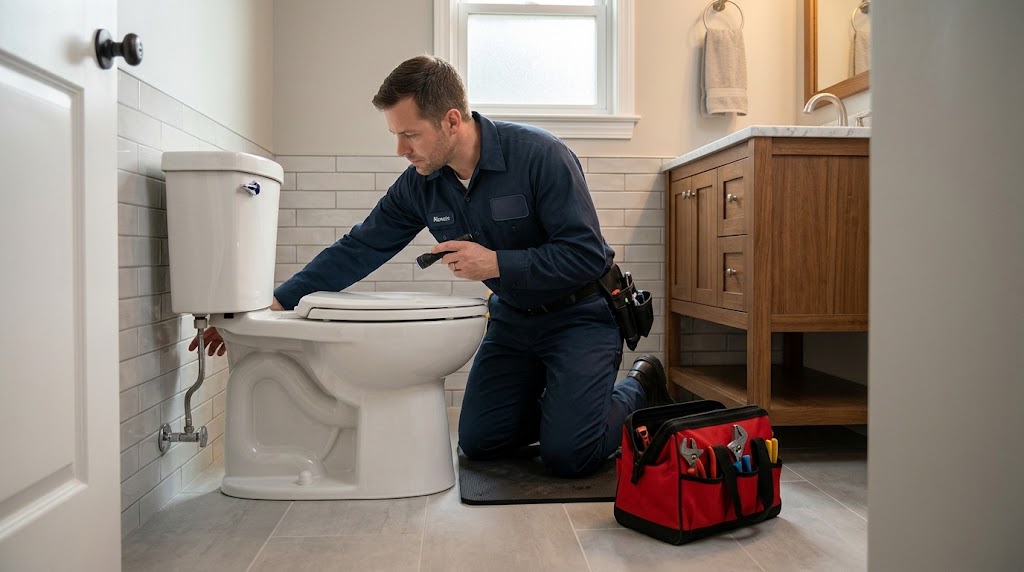
Fast, Professional Help When You Need It Most — specialized equipment and arctic-proven techniques to restore your plumbing quickly and safely.
When Interior winter temperatures plunge past −40°F, plumbing lines can freeze solid in minutes if insulation is compromised. Professional Fairbanks plumbers utilize safe electrical resistance thawers and steam jetting — never open flames — to defrost lines without damaging copper, PEX, or structure walls.
Fairbanks permafrost and extreme negative temperatures mean ground frost penetrates up to 10 feet. Lines routed through unheated crawlspaces, uninsulated floor cantilevers, or shallow trench runs require arctic insulation and heat trace tape.
Acoustic & Thermal Localization: Technicians pinpoint the exact ice plug location along hidden wall or crawlspace runs without destructive demolition.
Safe Non-Combustion Thawing: Connecting high-amperage electronic thawers or hot-water steam lines safely dissolves the ice dam from the outer edges inward.
Pressure Testing & Burst Repair: Once water flow is restored, lines undergo immediate pressure testing. Any micro-fissures or splits are cut out and replaced with arctic-rated pipe.
Understanding the equipment, capabilities, and safety factors involved in professional frozen pipe repair & thawing in Fairbanks.
| Thawing Method | Equipment Utilized | Safety Rating | Risk Factor in Fairbanks |
|---|---|---|---|
| Commercial Electro-Thermal | 400A low-voltage pipe thawing machine | Safest Method | Zero combustion risk; heats entire pipe run uniformly from joint to joint. |
| Pressurized Steam Jetting | High-temperature boiler wand with low-pressure feed | Safest for Plastic | Ideal for non-conductive PEX and ABS sewer lines; melts ice dam internally. |
| Propane Torch (Open Flame) | Handheld plumbing blowtorch | Extremely Dangerous | Leading cause of Fairbanks winter residential fires; creates explosive steam pressure. |
| Space Heater in Crawlspace | Electric portable coil heater | High Risk | Fire hazard near wood framing; inadequate for deep sub-floor ice dams. |
How professional contractors determine fair, upfront estimates for Fairbanks properties.
Evaluating crawlspace clearance, mechanical room layout, and isolation valve accessibility to safely stage commercial equipment without damaging finishes.
Commercial-grade tooling — including high-amperage thawers, fiber-optic color cameras, and hydro-jetters — involves specialized operation by trained technicians.
All replacement valves, piping, expansion bladders, and heating elements are specifically rated for Alaska sub-zero temperature swings and mineral water conditions.
Every service dispatch follows a rigorous 4-stage engineering protocol designed for Alaska mechanical resilience.
Technicians employ high-sensitivity infrared imaging cameras along exterior perimeter walls, cantilevered joist cavities, and unconditioned crawlspaces to map sub-zero thermal infiltration and pinpoint the precise start and end coordinates of the internal ice plug without invasive drywall demolition.
Downstream faucets and isolation ball valves are strategically opened to relieve massive internal hydrostatic expansion pressure. As trapped ice expands by roughly 9% in volume, releasing captive water prevents catastrophic longitudinal wall shear across copper and brass fittings.
For metallic copper and ductile iron runs, commercial low-voltage, high-amperage thawing units are clamped across the frozen segment. Heavy electrical resistance warms the entire circumference of the pipe uniformly, converting the ice plug into free-flowing water in minutes without hot spots.
Once normal circulation is achieved, lines are pressurized to standard residential operating levels (60 to 75 PSI) while monitored with digital test gauges for 20 minutes to verify that microscopic freeze-fissures have not developed before re-insulating and closing access points.
In extreme sub-zero environments, guesswork leads to catastrophic plumbing damage. Applying open heat guns or incorrect electrical grounding can ignite concealed framing or shatter frozen ceramic fittings. Our vetted Fairbanks plumbing contractors follow strict acoustic, thermal, and hydrostatic verification sequences before, during, and after every mechanical repair to ensure zero structural risk.
Proactive steps property owners can take to prevent emergency failures and extend equipment operating life.
Interior Alaska homes depend on commercial-grade self-regulating heat trace cables wrapped tightly along vulnerable water lines. Homeowners must verify power status and continuity before the first sub-zero freeze in October, ensuring pilot lights and GFCI breakers remain active.
During severe Fairbanks inversions, open all sink vanity cabinet doors along exterior perimeter walls to allow 68°F ambient room air to circulate directly around PEX and copper supply risers, preventing micro-climates from plummeting past the freezing point.
When sustained temperatures hover below -25°F, maintain a continuous, steady stream of cold water about the thickness of a pencil lead through the furthest fixture on the plumbing run. Moving water creates dynamic friction and continuously pulls warmer groundwater from below the frost line.
Inspect crawlspace skirting for broken foam boards or unsealed foundation vents. Cold drafts penetrating a 1-inch opening at -40°F can freeze an uninsulated copper pipe in less than fifteen minutes regardless of indoor thermostat settings.
What homeowners should expect when connecting with professional plumbing contractors in Fairbanks.
Reputable Interior Alaska plumbing contractors exclusively use commercial electrical resistance thawing rigs or enclosed low-pressure steam wands. They never operate open-flame propane torches inside residential structures.
All field technicians operate under verified Alaska Mechanical Administrator and Journeyman Plumbing credentials, ensuring full compliance with the State of Alaska Plumbing Code and Fairbanks North Star Borough ordinances.
Service vehicles carry pre-warmed inventory, arctic-grade PEX-A expansion fittings, heavy-wall foam insulation, and commercial heat trace kits so freeze repairs are permanently completed in a single site visit.
Answers to important questions about frozen pipe repair & thawing in Fairbanks, Alaska.
Using a propane torch is the number one cause of home fires in Interior Alaska during winter. In addition to torch flame contacting wood studs or paper-faced insulation, intense localized heat boils water inside the pipe, creating steam pressure bombs that can rupture pipes violently.
Open cabinet doors beneath exterior-wall sinks to circulate warm indoor air, let a thin pencil-lead stream of cold water run overnight, ensure crawlspace vents are sealed and insulated, and check that self-regulating heat trace cables are powered.
PEX-A has elastic memory and can expand slightly as ice forms, making it much more resilient than rigid copper. However, repeated freeze-thaw cycles or extreme expansion at brass fittings will still rupture PEX if the freeze is severe.
Depending on the length of the frozen run (typically 20 to 60 feet) and diameter of the copper pipe, electrical thawing usually restores flow within 20 to 45 minutes once the equipment is properly grounded and energized.
If the freeze is in an underground service lead between the city main or wellhead and your home, a plumber must insert a specialized steam tube through the interior water meter valve or curb stop to melt the subterranean ice blockage.